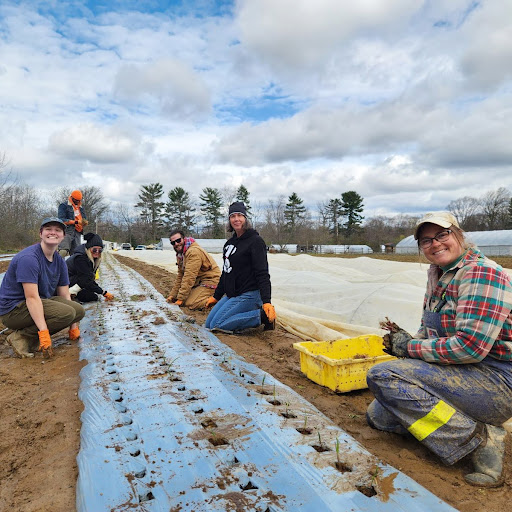

Our soil is a clay loam, which can provide some difficulties in the springtime when breaking ground for the first time in the season. Over the years we have figured out the best way to prepare our soil in the springtime, which differs from our strategies in the middle of the summer.
We have noticed in the last few years that we’ll have a good warm weather window in the middle of March in which we try to prepare some of our early crop beds like onions and brassicas. This is especially important because we deal with the seed corn maggot fly pest on our farm, a pervasive spring pest that lays its eggs in freshly worked ground. If the flies have the chance to lay their eggs in the field before we lay our plastic beds, we have to wait out their maggot lifecycle to plant. These maggots can wreak havoc on our young transplants, eating their roots and base of their stem, which can either kill or significantly stunt the plant. We have learned how to manage that pest over the years and the best way to deal with it is either beat the eggs or wait them out. There really is no in between. We haven’t noticed any significant impacts of waiting to plant our brassicas until early May. Since we are primarily a CSA farm, we just push our start date back a week or two. But I digress, back to the real topic of this post of preparing early spring ground!
In order to explain our spring strategies, I’m going to first preface with the implements we use. When the soil is dry enough, we first enter with our disc harrow. We will go through with the chisel plow next, and that sets our beds since the chisel plow is the width of our beds. The chisel plow breaks up any leftover hardpan underneath where the crops are going. Then we’ll use our Schaper Bros. Drop fertilizer cart to lay down our granular fertilizer. Our final tillage pass is either with the Perfecta harrow for most things, or the rototiller only for direct seeded crops.
The important step for us that we realized is that we need to disc more times in the spring. In our first few years, we would disc once, and then wait for it to dry to finish our bed prep. But this results in the large clay chunks drying in the sun into bricks which cannot be broken up with the perfecta harrow. The perfecta is one of our conservation tillage methods to improve our soil health, and we try to prioritize being able to use it in the spring. We were continually frustrated when laying plastic over huge dried clay chunks, and planting into it was difficult to say the least! We jokingly refer to the large spring chunks as “chunk fest”. We also read a forum post where a commenter said that his grandfather taught him that if his clay chunks dried in the spring, he’d never get rid of them til next year! And that feels true for sure sometimes.

As we learned how the perfect harrow is best used, we realized that the soil has to have just the right amount of moisture in order for the rolling basket on the back to break those chunks into beautifully prepared ground. So now, within the window of that warm weather, we will continuously disc, maybe twice a day. Once in the morning and once in the afternoon up until the day of final bed prep to continue to break up the chunks. We understand this is more tillage than we like/usually do, but it really is necessary for us in order to not allow those big clay chunks to dry in the sun or wind. It also pulls more moist soil up to the surface where it can dry. Depending on how the conditions of the field are and how short our dry window is, we sometimes opt to skip the chisel plow in those early beds because it can only bring up more wet chunks from deep below. We have sometimes gone straight to the perfecta harrow. We put more effort on the front end in order for our perfecta harrow to be used to the best of its ability and so we can avoid having to resort to using the tiller to break up chunks.
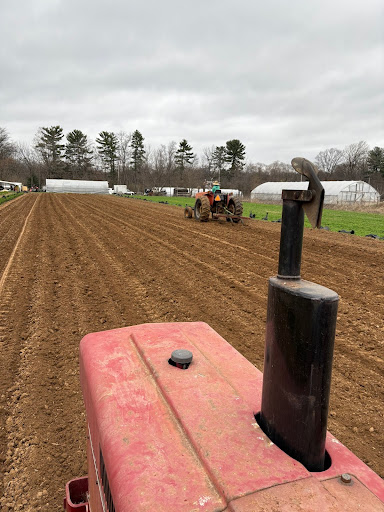
In the middle of the summer when our ground has already been worked throughout the season, we will disc much less to prepare ground. It is already more aerated than the heavy pancaked soil that has sat all winter settling. These spring windows can be fast and furious sometimes trying to get two weeks of work done in one! The other lesson we learned is to not compare our farm to anyone else’s, especially in the spring! It is very easy to see other farms post about getting into their ground, laying beds, or even planting. But it is important to sail your own ship. You know your farm’s soil the best and understand its language, what color of your soil when it is super wet, super dry or perfectly in between, and the texture when it’s ready to be worked. It’s very easy to feel behind or panicked when you see others working soil, but it is far better to put your blinders on and do what your farm asks!
Best of luck with spring field prep!