


Even though some of our crew members might be returning from year to year, we still have lots of new people joining our team each season. In the winter, we discuss all the ways we can share some of the important information necessary for the success of the crops with our team. Here’s some ways we go about this:
The first thing is we make our field map templates to hang on our office door for everyone to see. These templates are based on our 8 growing fields. Each field is created into a table on the page, one row in the table equals one bed in the field. Using the crop rotation map we’ve created for the season, we will enter each crop into the field templates, also writing out which varieties go exactly where and how much to plant. For instance, if one bed will be split between two varieties of summer squash, we will write “1/2 Golden Glory / 1/2 Zephyr”. We are careful to make sure the orientation of the field is correct and how we want it so anyone looking at the map knows where that bed is.
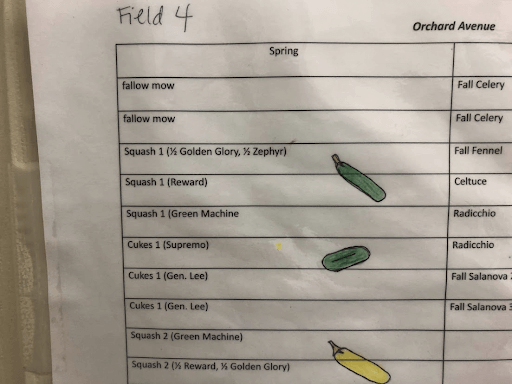
Once each field page is made for the season, we laminate them and hang them on the office door. This helps so that when we are having our team meeting in the morning, the maps are right there and we can point out to where crew members may be working. For instance, if we wanted to instruct someone to go weed the second succession beds of carrots, we can show them on the map exactly where they are.
They are also incredibly useful for when we are transplanting. We follow the maps when we are planting so we can keep track of where each variety is, especially if we are trialling a few and trying to compare their qualities. Even though it seems like you will remember where you plant things in the moment, it’s so easy to forget, and using the templates makes life so much easier. If for some reason we decide to change where something is planted, we do make the effort to go back to the template with a sharpie and update it. Why varieties or beds move can be due to a variety of factors, like how the plastic was laid, if we are seeing fertility issues throughout the season, or if we ran out of a variety and didn’t get to plant as much as we wanted. It’s super important to remember to go and update it so it accurately reflects what’s in the field. For instance, we didn’t like how the Kennebec seed potatoes we received looked. They were all sorts of different colors of mold growing on them, and we didn’t have as much faith in them. So we decided to plant less of that variety and more of Peter Wilcox. We made sure to update the potato field map so that when we needed to mow them for harvesting we knew where each variety was without having to go dig each bed up.
Recently, we completed our other document that will be really helpful, and we call it our “comprehensive management plan”. This plan compiles every action we might take on some of our biggest crops including fertilization, pest management, and disease management all in one document. It can be a lot to keep track of all the actions we might need to take on one particular crop, and this document is a great way for not only us, but any other apprentices or crew members, to keep track of these tasks.
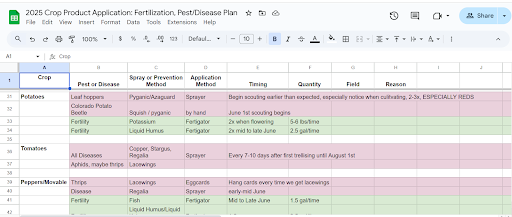
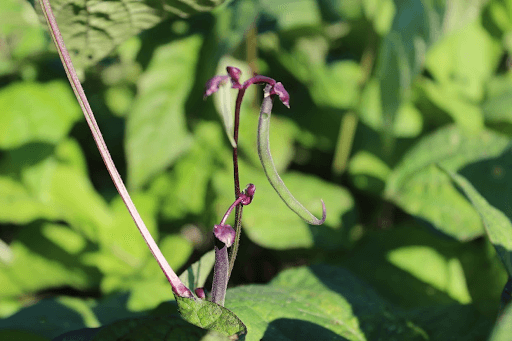
For any particular task that has a specific date, we set calendar reminders at the beginning of the year so we don’t forget. For instance, I set a reminder on June 1st to begin scouting for colorado potato beetles, or Kirstie will set a reminder to order green lacewings. Trent who is in charge of our green bean program will set reminders to order his Pediobus wasp mummies to hang in the beans throughout the summer.
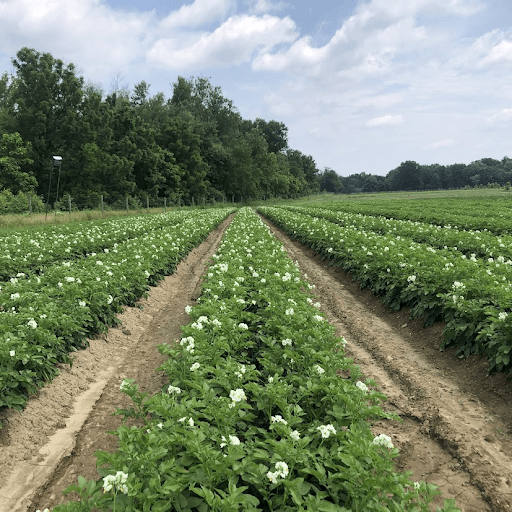
Sometimes though, things don’t have a specific date but more phenological date. For example, some of our fertility measures are when a plant gets to a certain life stage. When the potatoes start flowering, I know it’s time to send the potassium down the drip lines. When the winter squash begin flowering, we send fish down the lines, but stop when we start to see little fruits. We believe fertigating with fish should stop when the fruits begin to form because we don’t want them to taste like fish! When the summer squash begin to flower it’s time to clean up the row cover. Sometimes the task has not much to do with the plant, but more with the weather. We uncover our kale and chard at a certain time because it gets too hot under the row covers, but we won’t know when that will be until it happens.
We use Google Drive so all these documents are easily accessible out in the field. We do share them with some of our crew members, and that can help them feel like they can check them anytime. The more our crew can be apprised of what is going on, the better our season will be. I’ll be writing next week’s blog all about our acronym and method of keeping track of the details: ABAA CADIABRA! So tune in next week if you want to find out about what that stands for!