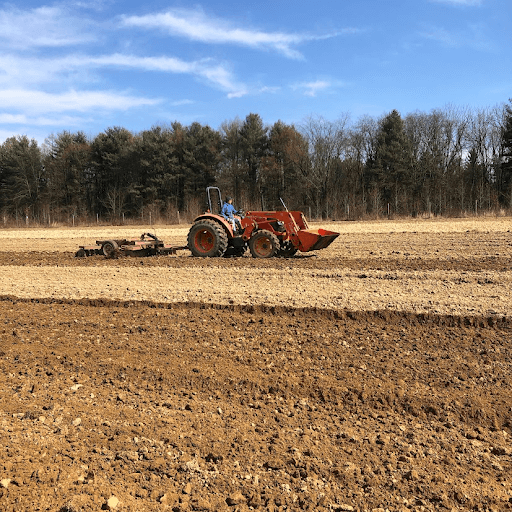

We do a few things for our tractors to upkeep them through the wintertime.
Right when the temperatures are just starting to get cold and our use of the tractors is done for the year, we fill all the tanks up to full capacity and add fuel stabilizer. An empty fuel tank has a lot of air space in it, allowing water vapor to condense as temperatures fluctuate in the winter. When water moisture collects, it can corrode the tank, fuel lines, and for gas engines the carburetor.

Our big tractors getting fueled up for winter
We have both diesel and gasoline tractors on the farm. From largest to smallest diesel we have a Kubota M5-111, Allis Chalmers 6080, Kubota M6040, International Hydro 84, and a Kubota L245H. The gasoline tractors are our oldest, our 1941 Farmall A and the 1950s era Allis Chalmers G. Some people recommend running a gas engine out of fuel for the winter, but this can cause more problems, as we have seen. The first few years of managing, we ran the Farmall A and the G out of fuel. But that empty tank allowed moisture to condense, and caused rust to build up on the inside of the fuel tank. When we filled the tanks up in the springtime, rust particles dislodged and clogged the fuel lines and carburetor. We had to remove both of these tractors’ fuel tanks and have them refinished by our local mechanic who will work on these older tractors (thankfully! Mike at Little’s John Deere is a lifesaver!). Now we fill all our tanks, gas and diesel both, with stabilized gas. We also fill all our portable fuel containers with fuel and stabilizer.
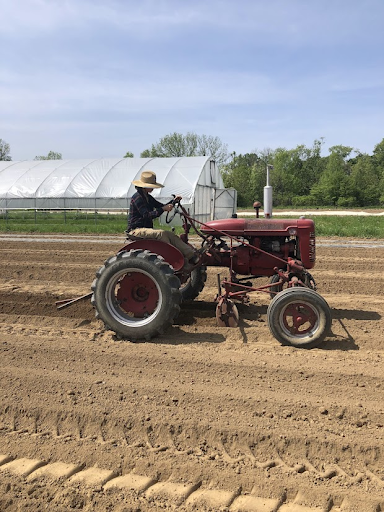
The Farmall A used for hilling potatoes
The next thing we do with our tractors is charge the batteries. We have a trickle charger that migrates around to each tractor throughout the winter to keep the batteries healthy. This helps prolong the life of the battery. All of our tractors are all protected for the winter in either a storage hoophouse or our new pole barn.
Every year we also perform routine yearly maintenance on all our tractors. This usually includes oil change, oil filter, air filter, hydraulic filter, and roughly every other year hydraulic fluid change. We also grease any fittings needed. We have a spreadsheet that has separate tabs for each tractor where we can log any maintenance. This helps us keep track of when repairs or work was done on the tractor. Typically those routine maintenance tasks are determined in the manual based on tractor’s running hours.
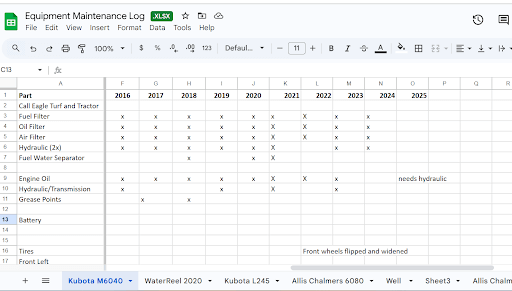
Equipment Maintenance Log
We also have a spreadsheet with all the filters needed for each tractor, where we purchased them last year, and their part numbers. It can be really difficult finding replacement parts because the same places don’t always carry the same filters, or sometimes the part numbers change. The websites usually have which model tractors it fits somewhere listed under the filter. The air filters can sometimes be the trickiest because they are labeled for the model tractor but when we order it, they don’t fit. Sometimes it’s a little trial and error. The reason I am writing this blog this week is that we try to have all our tractor parts ordered as soon as possible in the new year so that we can begin doing tractor maintenance. If something comes up during maintenance, you want to have time to repair it before its needed. Don’t wait til the last minute!
We also assess any necessary repairs or preventative care the tractors need in addition to regular yearly maintenance. Sometimes we send our little old tractors in for a little TLC and tune-up since they are a little more fussy. This year, we are going to send our Kubota M6040 in to our local Kubota dealer (Eagle Power Turf & Tractor) for preventative maintenance and checkup. The exhaust pipe needs straightening after a bump into the hoophouse frame where it’s parked, a new seat and armrests, which are totally frayed and losing sponge! It’s also important to remember the little things like the seat belt because that tractor has a bucket and is used to scoop compost. It is much safer to use the seat belt with the ROPS for whenever using the bucket. The seat belt was no longer clicking securely a few years ago, so when it got sent in for its preventative care, we had it replaced.
One of our funnier projects we wanted to have done was for our Allis Chalmers 6080. It is a powerhouse of a tractor and did most of our heavy duty field work for many years. It has nearly 8,000 hours on it. It, also being from the 80s, is NOT the most clean when it comes to emissions. In fact, many of those older tractors really have bad exhaust and we worry about breathing it in. We do wear high quality particulate filtering masks when we use the Farmall A, the G, and the 6080. The 6080’s exhaust pipe originally was much taller than the driver. However, the tractor we have was modified at some point and the exhaust stack cut much lower, probably to have it fit in a storage shed. When the tractor was younger and was a little cleaner, we didn’t notice the emissions as much. But as it’s gotten older it has gotten worse, and much worse for the driver. So we had Eagle Power add on a very Dr. Seuss looking exhaust stack to get the exhaust away from the driver. This was also before our pole barn was built and our tractor had to fit in a much smaller storage shed, so they creatively welded on this wonky exhaust pipe! But it fit into our previous shed. Now with the M5-111, the 6080 is slowly being put into retirement and only is used to chisel plow at this point.
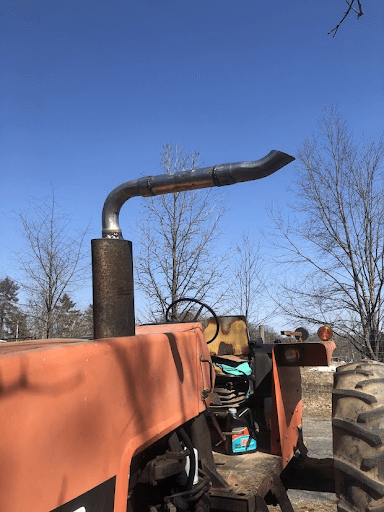
Allis Chalmers 6080’s new exhaust pipe for a small storage shed
The tractors also benefit from a good cleaning. The Kubota M6040 is one of our main discing and rototilling tractors, and with the summer being so incredibly dry, it is just covered in fine dirt everywhere. All the controls are a little sticky and difficult to use. This coming year, if its as dry as it was, we may consider spraying down our tractors periodically through the season.
The main takeaway is don’t wait for tractor maintenance. We once waited too long for our International Hydro 84, and it ended up needing to be sent away for a more complicated repair and we didn’t have it for our first round of field work! So don’t delay!