


Before we begin placing our seed order for the year, we inventory our supply from this past season. We have our seeds separated by crop family in nice tupperware containers. We take each box over to a table, open it up and take out its contents. We take our notepad and write down the variety name. Then we estimate how much is left in the packet, and we note how much was left and of what size packet. In year’s past, we have been so technical as to weigh the packets at the beginning of the seeding and afterwards, but we find that it’s extra work that doesn’t really make too much of an impact on our seed order the following year. We can estimate pretty well.

The other thing we do with each packet is circle the germination test date and write “emergency” on the packet. We will keep these seeds from last year still in the seed box, in case of an emergency: we need to reseed because mice ate the seeds, we ran out of another variety, etc. Most seeds stay viable in good storage conditions for a few years.
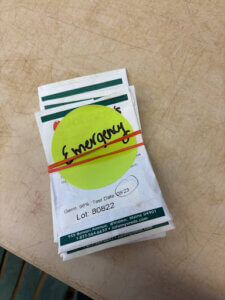
2024 Seeds Saved For Emergencies in 2025
If we have any unopened packets, we will mark on the packet “Use for 2025”. In our seed order spreadsheet, we will make a notation that we are using old seed and adjusting the number of packets we order so that when we do the seed order the following year we know to potentially adjust the numbers back.
If we end up having a lot of leftover seed or many unopened packets, we go ahead and adjust the number of seeds we order. Our goal is to have some buffer for those emergencies and overseeding for germination rates, but we want it to be as accurate as possible.
When we calculate the number of extra seeds we need, we think about how many total plants are needed and also how many seeds we usually drop into each hole in the flats. It also depends on the general germination rate. For instance, brassicas usually have a high germination rate, somewhere between 90-99%. This means that I don’t have to overseed the flats that much. I usually overseed by ⅓, so if we seed into 72s, I drop one seed in each hole, and then a second one in 24 out of 72 holes. That’s 96 seeds per tray. This accounts enough for the germination rate and we’ll have plenty of extras to use for thinning. That means if we plant one 300 ft. row of Winterbor Kale, 3 rows/bed at 1 foot spacing, we have 900 Winterbor plants needed. 14 trays is enough for one whole bed plus some extra plants in case replanting is needed, so that’s 1,344 seeds per bed. Multiply that by however many successions we have, which is 2, so that’s a total of 2,688 total Winterbor seeds needed. Looking at the Johnny’s website, they have a 250, 1,000, and 5,000 seed size packets. We would purchase three 1,000 size packets.
Johnny’s has a lot of great resources to calculate seeds under their grower library. We have used it often for calculating how much to buy for direct seeded crops like carrots. Now we have our number of seeds we usually get and work off of that each year.
Once we receive the seed deliveries, we open the box and lay out the contents. At this point we are very careful to inventory exactly what we have received. We do a double check making sure the variety and quantity we received is the same as on the packing list, our actual seed order that was placed, and our spreadsheet with what we wanted for the year. We always take notes about which varieties might be back ordered so that we can remember they are not on the farm and we are waiting to receive them. This is important in case those back order dates change and they will arrive later than when you might schedule to seed that variety. We also want to make sure we received the quantity we wanted. Every so often there will be a mistake where something is on the packing list, and it was not put in the box, or we might not have gotten enough packets of something. Being diligent pays off so you don’t get to a busy seeding week and find out you don’t actually have what you need!
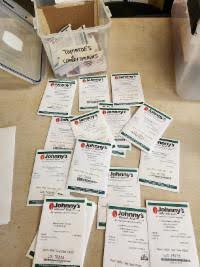
Double Checking We Received All the Varieties We Need
Once the seed packet is triple confirmed, as the greenhouse manager, I place it in its correct box location. I usually place a brown rubber band around any variety that has multiple packets together. I sort out within the boxes some different categories, for instance the regular head lettuce is separate from the salanova, the cherry tomatoes separated from the big tomatoes, and the hot peppers from the sweets. This helps make sure if I am not the only one seeding that they are grabbing the correct seed packets. I also like being the person to actually place them in the boxes because then I can make sure everything makes it in a place that makes sense for me to find them later. With over 150 varieties of 60 different crops, misplacing a packet is a possibility. Save myself some time later searching through other boxes if I put them away. The bundles of emergency old seeds will be rubber banded with a red rubber band and placed in the back of the box.
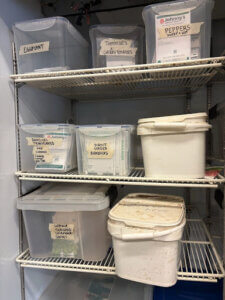
Our Seeding Cabinet
Also, I place any tool purchased for seeding in the seeding cabinet, like extra tape, special markers that don’t fade, etc so that I know where they are when I need them. One also random thing we make sure we get for the seed cabinet is pantry moth traps. We placed a bag of cover crop in the bottom of the seed cabinet one year and a bunch of pantry moths hatched and got into our regular vegetable seeds. Luckily it was nearly the end of the year and almost all the seeding was done for the season, but we would have lost hundreds of dollars worth of seeds! Get the pheromone traps and leave them in there to control any possible pest populations!