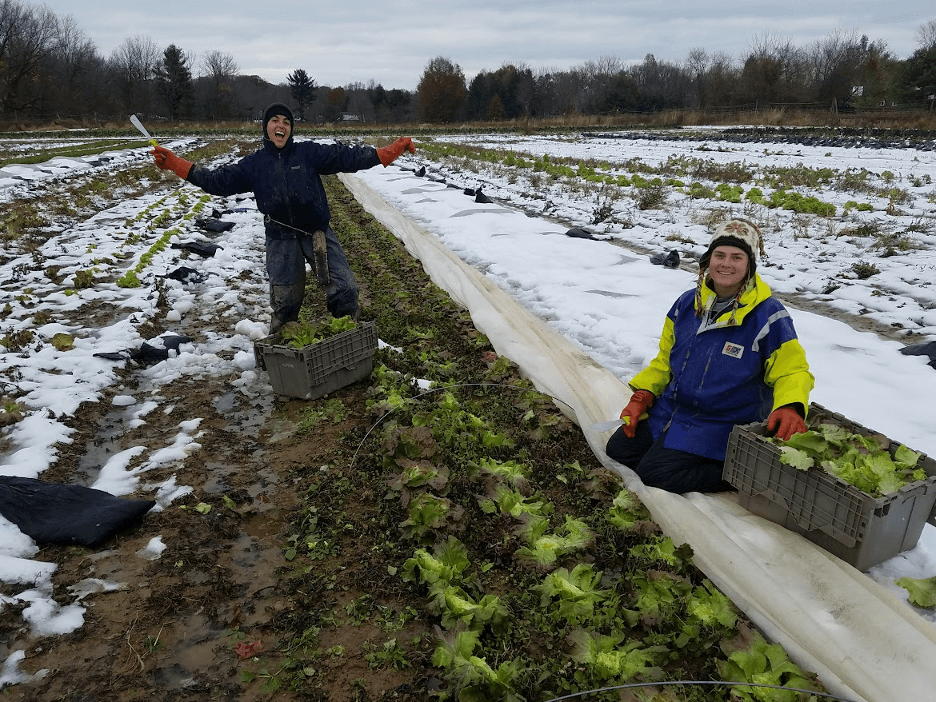

When people hear we continue to farm and work outside in the winter, the first question people ask is: “how do you do it?! Isn’t it freezing?”. And our answer always is, yes it can be cold on particularly rainy, wet, or during very deep cold snaps, but it’s all in how you dress! Most of the way people dress during the winter is to be inside. So the walk between the car and work or home can be frigid. It’s all in the layers and preparation.

The best way to combat the cold is lots of layers that you can shed if and when you get hot. Doing a lot of physical work even on the coldest days can make you work up a little sweat. And sweat, or getting wet, is the worst thing possible as it saps your body heat and can make you extremely cold very quickly. So we want to be able to shed layers as needed to prevent sweating, and be able to put them back on when we slow down.
Our typical base layers are long underwear/leggings. On a typical winter day, I will wear fleece lined leggings on the bottom layer, another pair of regular leggings over top. Then I have my Duluth Heirloom Bib overalls overtop of that. On a really cold day where the high might only be in the 20s, I may wear two pairs of fleece lined leggings. The overalls help keep your core warm as there is no gap between your pants and shirt to be exposed to cold air as you bend over. There are fleece lined overalls from Carhartt and Duluth as well. Snow pants are always an option for extra warmth as well.
For the top layers, I usually wear a long sleeved shirt, a tee shirt overtop of that, a lightweight fleece flannel, another medium weight fleece flannel, and one more layer on top, my heavyweight flannel or canvas coat. This allows me to shed layers very easily as I get warm moving sandbags or cleaning up the fields. I’ll want all my layers on when we are harvesting spinach and not moving around a lot.
The next most important layers are good accessories: hats, gloves, socks, boots, and neck warmer. A good hat that covers your ears is a must. I prefer hats that you can tie or latch under your chin for those extra windy days. A neck gaiter is great to keep the wind out of your top layers and can be pulled up and over your nose for bitter cold.
Socks are a game changer. For those of us whose feet get clammy or cold sweat in rubber work boots in the cold weather, using lightweight toe socks underneath a pair of wool socks helps tremendously. I like the Injinji toe sock liners. They help keep my feet less clammy and warmer! Two layers is pretty standard whether or not you go with the toe socks.
Boots must be waterproof. Warmer snow boots are great for snow or extreme cold, but can be clunky and too heavy to walk in the winter fields that are always muddy. A nice pair of muck boots like the Muck Boot Co.s Muckster II Mid can be regular or fleece lined. But without a doubt, Dry = Warm. We also use toe warmers on a regular basis, and if it’s extra cold you can put one toe warmer on the bottom of your foot and one on top to keep toasty. The other thing about winter is boot maintenance. You always want to place your boots in a warm dry location for the night to completely dry for the next day in case they were a little clammy by the end of the day. Boot dryers are a must. Dry = Warm cannot be overstated!
Gloves is perhaps one of the most important accessories in the winter. The trick is finding gloves that keep you warm but are not so thick that you lose dexterity. I have three different pairs of gloves for different tasks.
For tasks I need the most dexterity, like harvesting, I combine thin MaxiFlex gloves with Venom Steel rip-resistant nitrile gloves. Nitrile gloves are a great trick for waterproofing any of your gloves. Dry = warm! I love how much dexterity I have with these, especially for handpicking spinach or kale. For those who get particularly cold, finding a heated glove liner that goes under the nitrile gloves has worked well for people on the farm in the past.
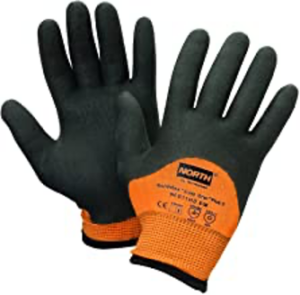
For most of our winter activities, I use the Honeywell Northflex gloves. Always important to find gloves that are all finger or whole glove dipped in waterproof pvc. Dry = warm!
I’d recommend North by Honeywell NFD11HD/8M Northflex Cold Grip ¾ dipped palm-coated gloves , total finger dipped glove. Fleece-lined and waterproof around your fingers is key.
For winter washing, it is essential to have a pair of these Atlas Vinylglove 460 Insulated gloves.
The last part of winter gear we use is our regular rain gear. The fields are often super muddy or you may be at the washstation washing. My favorite company for rain gear is Stormline. Even though they may be a little pricier, you are paying for excellent quality PVC rain gear that fits well and lasts a long time on the farm. I love the raincoats they offer with adjustable neoprene cuffs attached to the farm. It prevents water from dripping into and down your sleeve.